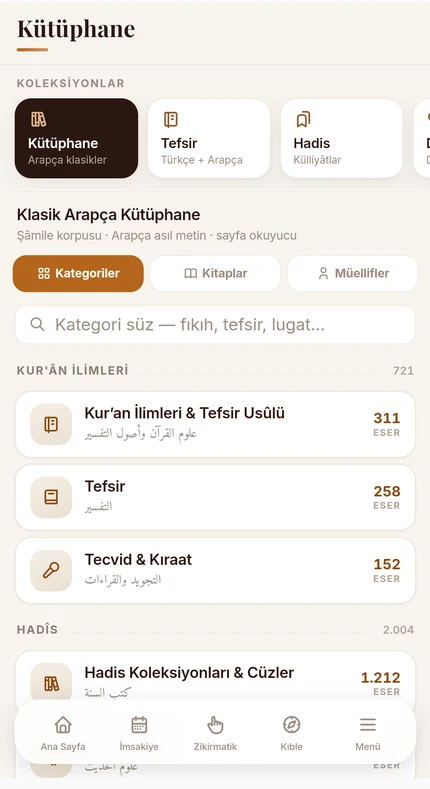
İslam Arşivi artık mobilde
Binlerce kaynağa her an, her yerden ulaşın.
Web sitemizde bulunmayan özellikleri uygulamada keşfedin.
iOS ve Android uygulamalarımız şimdi yayında!
Güvenli • Hızlı • Ücretsiz
سُبْحَانَ رَبِّيَ الْعَظِيمِ
(Repeated three times)
Subḥāna Rabbiya al-ʿaẓīm. (3 times)
I declare my Most Great Lord free of all imperfect attributes.
Source: Sahih Muslim 772 (a sahih (authentic) hadith).
Narrated by Hudhayfah (may Allah be pleased with him) and Uqbah ibn Amir (may Allah be pleased with him). The Prophet (peace and blessings be upon him) used to say "Subhana Rabbiya al-Azim" in the bowing. (Sahih Muslim, Salat 772; Sunan Abi Dawud, Salat; Jami' at-Tirmidhi, Salat)
Hudhayfah (may Allah be pleased with him) relates: "I prayed together with the Prophet (peace and blessings be upon him). When he went into the bowing he said, 'Subhana Rabbiya al-Azim.'" Uqbah ibn Amir (may Allah be pleased with him) narrated something similar. This dhikr was our Prophet's constant practice in the bowing and is among the most important sunnahs of the ruku. According to the Hanafi school, saying "Subhana Rabbiya al-Azim" at least three times in the bowing is a sunnah.
The bowing is the finest expression of the servant's submission before Allah the Exalted and of his acknowledgement of His majesty. While the servant bows with his body in the ruku, with his tongue he glorifies the loftiness of his Lord. The phrase "Subhana Rabbiya al-Azim" carries the meaning "My Most Great Lord is far above every imperfection." This dhikr is a tasbih that expresses at one and the same time the servant's helplessness before Allah and the majesty of his Lord.
In one of his noble hadiths our Prophet (peace and blessings be upon him) said: "The state in which a servant is closest to his Lord is the state of prostration." The bowing is the first step towards this nearness. Indeed, in the Noble Qur'an it is said, "Prostrate and draw near" (al-Alaq 19); the bowing and the prostration are mentioned together. Saying this tasbih in the bowing is an important element of the believer's spiritual communication with his Lord five times a day in his daily life.
My Most Great Lord, You are far above every deficiency. I am a servant of Yours who bows to You, who submits, and who acknowledges his own helplessness. I glorify Your loftiness. In my bowing I turn to You with humility. Make me one of Your servants who have humility in the salah. Grant me to bow before Your majesty and to have the honour of servitude to You, O my Lord. Amin.