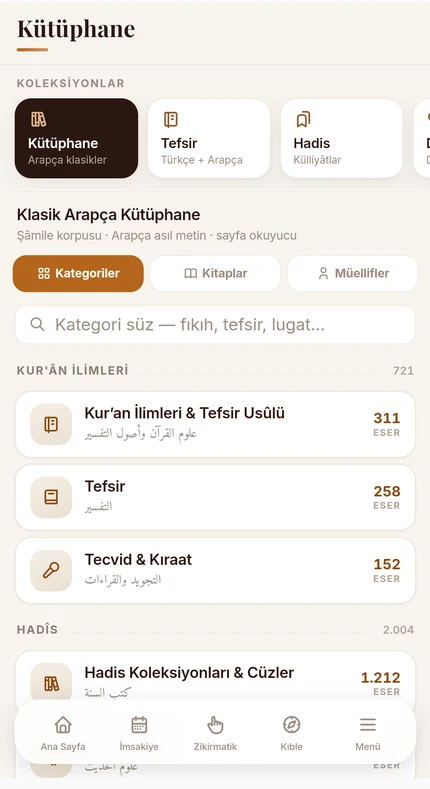
İslam Arşivi artık mobilde
Binlerce kaynağa her an, her yerden ulaşın.
Web sitemizde bulunmayan özellikleri uygulamada keşfedin.
iOS ve Android uygulamalarımız şimdi yayında!
Güvenli • Hızlı • Ücretsiz
سُبْحَانَكَ اللّٰهُمَّ وَبِحَمْدِكَ وَتَبَارَكَ اسْمُكَ وَتَعَالَى جَدُّكَ وَلَا إِلٰهَ غَيْرُكَ
(The portion added in the funeral prayer: وَجَلَّ ثَنَاؤُكَ)
Subḥānaka llāhumma wa bi-ḥamdika wa tabāraka smuka wa taʿālā jadduka wa lā ilāha ghayruk.
(In the funeral prayer: ...wa jalla thanāʾuk...)
O Allah! I declare You free of every imperfection. I glorify You only with praise of You. Your name is blessed and Your majesty is exalted. There is no god other than You.
Source: A dua recited within the salah (prayer) (sahih [authentic] hadith).
Narrated by Aishah (may Allah be pleased with her): When the Prophet (peace and blessings be upon him) began the prayer he would say, "Subhanaka llahumma wa bi-hamdik..." This narration was transmitted by Abu Dawud, at-Tirmidhi and an-Nasa'i. In his Sahih, Muslim narrated that Umar (may Allah be pleased with him) recited this dua aloud.
The Subhanaka dua is the first dua our master the Prophet (peace and blessings be upon him) recited immediately after the opening takbir. According to the narration of our mother Aishah (may Allah be pleased with her), the Messenger of Allah recited this dua every single time he began the prayer. Abu Sa'id al-Khudri (may Allah be pleased with him) related that when our Prophet rose for the night prayer he recited this dua after taking the takbir. This shows that the Subhanaka is an indispensable sunnah of the salah (prayer).
According to the Hanafi school it is sunnah to recite it at the beginning of every prayer, immediately after the opening takbir. In funeral prayers it is recited with the addition "wa jalla thana'uk". With this dua the Prophet (peace and blessings be upon him) expressed the exaltedness of Allah; on taking the takbir and beginning the prayer, praising His exaltedness was the first thing he did. That it is also among the first duas taught to children shows its fundamental place in Islamic education.
In Muslim's Sahih, Umar (may Allah be pleased with him) recited this dua aloud, and in this way the congregation learned it too. This narration shows that the noble Companions took care to learn the duas our Prophet recited directly from him, and that these duas were passed on from generation to generation.
O Allah, You are far removed from every deficiency. I begin my prayer praising You. Your name is exalted and Your majesty is great. Grant me success in praying with humility and in being a servant worthy of You. Bind my heart to You and keep my tongue occupied with Your remembrance. Grant me that I remember You and thank You at every moment of my life, O Lord. There is no refuge other than You, no god other than You. Amin.