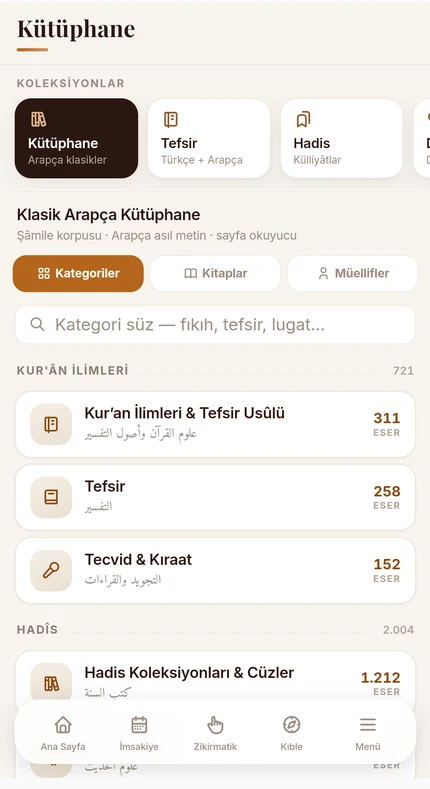
İslam Arşivi artık mobilde
Binlerce kaynağa her an, her yerden ulaşın.
Web sitemizde bulunmayan özellikleri uygulamada keşfedin.
iOS ve Android uygulamalarımız şimdi yayında!
Güvenli • Hızlı • Ücretsiz
اَللّٰهُمَّ بِكَ أَمْسَيْنَا وَبِكَ نَحْيَا وَبِكَ نَمُوتُ وَإِلَيْكَ الْمَصِيرُ
أَمْسَيْنَا وَأَمْسَى الْمُلْكُ لِلّٰهِ وَالْحَمْدُ لِلّٰهِ لَا إِلٰهَ إِلَّا اللّٰهُ وَحْدَهُ لَا شَرِيكَ لَهُ لَهُ الْمُلْكُ وَلَهُ الْحَمْدُ وَهُوَ عَلَى كُلِّ شَيْءٍ قَدِيرٌ رَبِّ أَسْأَلُكَ خَيْرَ مَا فِي هٰذِهِ اللَّيْلَةِ وَخَيْرَ مَا بَعْدَهَا وَأَعُوذُ بِكَ مِنْ شَرِّ مَا فِي هٰذِهِ اللَّيْلَةِ وَشَرِّ مَا بَعْدَهَا
Allāhumma bika amsaynā wa bika naḥyā wa bika namūtu wa ilayka l-maṣīr.
Amsaynā wa amsā l-mulku li-Llāhi wa-l-ḥamdu li-Llāh. Lā ilāha illā Llāhu waḥdahu lā sharīka lah, lahu l-mulku wa lahu l-ḥamdu wa huwa ʿalā kulli shayʾin qadīr. Rabbi asʾaluka khayra mā fī hādhihi l-laylati wa khayra mā baʿdahā wa aʿūdhu bika min sharri mā fī hādhihi l-laylati wa sharri mā baʿdahā.
O Allah! By Your grace we have reached the evening. By Your will we live and by Your will we die, and to You is the return.
We have entered the evening. All dominion belongs to Allah. All praise belongs to Allah. There is no god but Allah alone; He has no partner. His is the dominion and His is the praise, and He has power over all things. My Lord! I ask You for the good of this night and the good of what comes after it. I seek refuge in You from the evil of this night and the evil of what comes after it.
Source: Jami' at-Tirmidhi 3391 (sahih (authentic) hadith).
Narrated by Abu Hurayrah (may Allah be pleased with him) and Ibn Mas'ud (may Allah be pleased with him). The Prophet (peace and blessings be upon him) used to recite these duas in the evening. (Sahih Muslim, Dhikr 74-76; Sunan Abi Dawud, Adab 101; Jami' at-Tirmidhi, Daawat 13)
Ibn Mas'ud (may Allah be pleased with him) relates: "The Messenger of Allah (peace and blessings be upon him) used to recite this dua in the evening, beginning with 'Amsaynā wa amsā l-mulku li-Llāh...'" (Sahih Muslim, Dhikr 74-76). The time of evening is a reminder of the passing away of the world, of the exhausting and ending of one's life span, and of the finish of all things.
In his evening dua the Prophet would ask Allah for the good of that night and for the good of what came after it, seek refuge from its evil, ask to be protected from laziness and from the wretchedness that old age brings, and take refuge with Allah from the Fire and from the punishment of the grave. In the morning he would recite the same dua saying "aṣbaḥnā."
Evening is the hour at which a person has left one more day of his life behind him, the hour at which one more day has been subtracted from his lifetime. To meet this moment with dua, to take account of the day, to ask Allah for good for tomorrow and for protection from evils, is the finest expression of servanthood.
O Allah! By Your grace I have reached the evening. The dominion is Yours and the praise is Yours. I ask You for the good of this night and the good of what comes after it. I seek refuge in You from the evil of this night and the evil of what comes after it. Protect me from laziness, from the old age that brings wretchedness, and from the Fire and the punishment of the grave, O Lord. Amin.