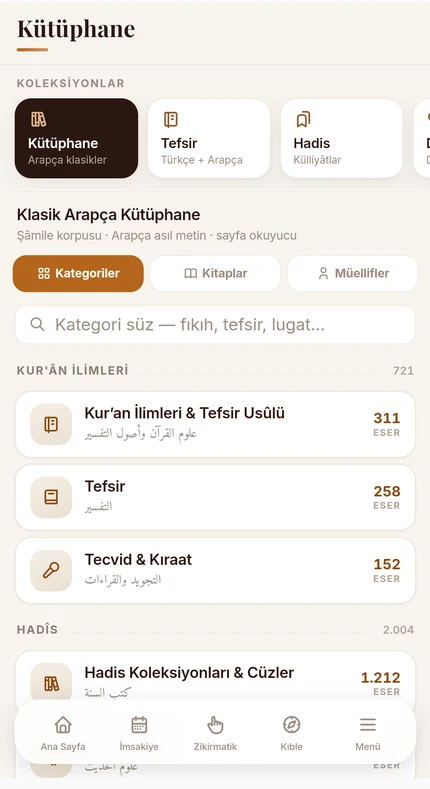
İslam Arşivi artık mobilde
Binlerce kaynağa her an, her yerden ulaşın.
Web sitemizde bulunmayan özellikleri uygulamada keşfedin.
iOS ve Android uygulamalarımız şimdi yayında!
Güvenli • Hızlı • Ücretsiz
اَللّٰهُمَّ لَكَ أَسْلَمْتُ وَبِكَ آمَنْتُ وَعَلَيْكَ تَوَكَّلْتُ وَإِلَيْكَ أَنَبْتُ وَبِكَ خَاصَمْتُ وَإِلَيْكَ حَاكَمْتُ فَاغْفِرْ لِي مَا قَدَّمْتُ وَمَا أَخَّرْتُ وَمَا أَسْرَرْتُ وَمَا أَعْلَنْتُ أَنْتَ الْمُقَدِّمُ وَأَنْتَ الْمُؤَخِّرُ لَا إِلٰهَ إِلَّا أَنْتَ
Allāhumma laka aslamtu wa bika āmantu wa ʿalayka tawakkaltu wa ilayka anabtu wa bika khāṣamtu wa ilayka ḥākamtu. Faghfir lī mā qaddamtu wa mā akhkhartu wa mā asrartu wa mā aʿlantu. Anta'l-muqaddimu wa anta'l-muʾakhkhir. Lā ilāha illā anta.
O Allah! To You I have submitted, in You I have believed, upon You I have relied. I have turned my face and my heart to You. With Your help I have contended against enemies. I have referred my case to Your judgement. Forgive what I have done before and what I will do later, what I have concealed and what I have made public. You are the One who brings forward and You are the One who puts back. There is no deity but You.
Source: Sahih Muslim 771 (sahih [authentic] hadith).
Narrated by Ibn Abbas (may Allah be pleased with him). The Messenger of Allah (peace and blessings be upon him) used to say this dua regularly. (Sahih Muslim, Dhikr 67/2717; Sahih al-Bukhari, Tahajjud 1; Sunan Abi Dawud, Salah 119; Jami' at-Tirmidhi, Da'awat 29)
Ibn Abbas (may Allah be pleased with him) relates: "The Messenger of Allah (peace and blessings be upon him) used to say regularly: 'Allahumma laka aslamtu...'" (Sahih Muslim, Dhikr 67/2717). This is the dua of reliance upon Allah that the Prophet recited in the night salah (prayer) and the dawn salah.
This dua contains six affirmations and commitments: submission (I have yielded to You), faith (I have believed in You), reliance (I have depended on You), turning back to Allah (I have turned to You), striving (with Your help I have contended) and seeking judgement (I have referred my case to You).
Then come four requests for forgiveness: the forgiveness of all sins, past and future, hidden and open. This covers the four dimensions of the human being: forgiveness of every sin is sought in the dimension of time (past and future) and of place (hidden and open).
The phrase "Anta'l-muqaddimu wa anta'l-mu'akhkhir" (You are the One who brings forward and You are the One who puts back) emphasises that time and events are under Allah's control, that He brings forward what He wills and puts back what He wills. The dua ends with the final declaration of oneness, "La ilaha illa anta."
O Allah! To You I have submitted, in You I have believed, upon You I have relied. I have turned my face and my heart to You. Forgive my past, my future, what I hide and what I show. You are the One who brings forward and You are the One who puts back. There is no deity but You. Make us servants who have submitted to You, O my Lord. Amin.