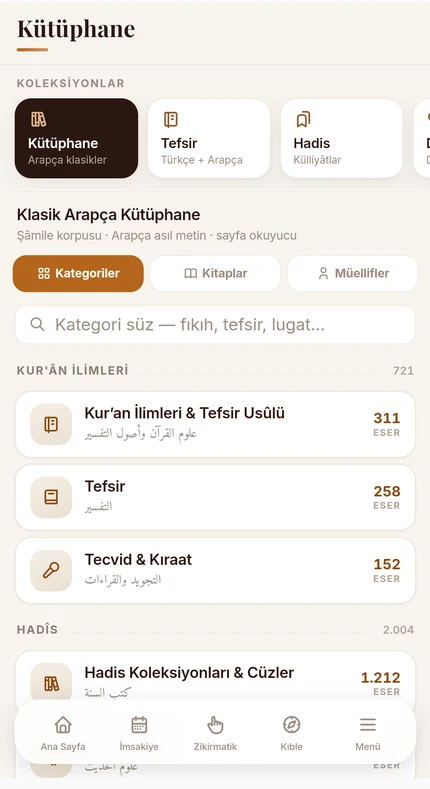
İslam Arşivi artık mobilde
Binlerce kaynağa her an, her yerden ulaşın.
Web sitemizde bulunmayan özellikleri uygulamada keşfedin.
iOS ve Android uygulamalarımız şimdi yayında!
Güvenli • Hızlı • Ücretsiz
لَا إِلٰهَ إِلَّا اللّٰهُ وَحْدَهُ لَا شَرِيكَ لَهُ لَهُ الْمُلْكُ وَلَهُ الْحَمْدُ وَهُوَ عَلَى كُلِّ شَيْءٍ قَدِيرٌ اَللّٰهُمَّ لَا مَانِعَ لِمَا أَعْطَيْتَ وَلَا مُعْطِيَ لِمَا مَنَعْتَ وَلَا يَنْفَعُ ذَا الْجَدِّ مِنْكَ الْجَدُّ
Lā ilāha illa'llāhu waḥdahu lā sharīka lah. Lahu'l-mulku wa lahu'l-ḥamdu wa huwa ʿalā kulli shayʾin qadīr. Allāhumma lā māniʿa limā aʿṭayta wa lā muʿṭiya limā manaʿta wa lā yanfaʿu dha'l-jaddi minka'l-jadd.
There is no deity but Allah. He is One; He has no partner. Sovereignty belongs to Him and all praise belongs to Him. He has power over all things. O Allah! There is no power that can withhold what You give, and there is none who can give what You withhold. The wealth of a wealthy man is of no benefit to him with You.
Source: Sahih al-Bukhari 6115 (sahih [authentic] hadith).
Narrated by al-Mughirah ibn Shu'bah (may Allah be pleased with him). The Messenger of Allah (peace and blessings be upon him) used to recite this dua after every obligatory salah (prayer). (Sahih al-Bukhari, I'tisam 3, Riqaq 22/6115; Sahih Muslim, Aqdiyah 12; Sunan Abi Dawud, Witr 25)
Al-Mughirah ibn Shu'bah (may Allah be pleased with him), in the letter he sent to Mu'awiyah, transmitted this dua, saying, "The Prophet (peace and blessings be upon him) used to make this dua after every obligatory salah (prayer)" (Sahih al-Bukhari, I'tisam 3/6115; Sahih Muslim, Aqdiyah 12).
This dua contains expressions of divine oneness, praise and reliance upon Allah. The first part is the affirmation of oneness: "La ilaha illallah" means there is no deity but Allah. "Wahdahu la sharika lah" means He is One and has no partner. "Lahu'l-mulku wa lahu'l-hamd" declares that sovereignty and praise belong to Him alone.
The second part is a dua of reliance: the phrase "La mani'a lima a'tayta" (there is no power that can withhold what You give) states that if Allah has willed to give, no one can prevent it. "Wa la mu'tiya lima mana'ta" (there is none who can give what You withhold) explains that if Allah does not give, no one can give. And "Wa la yanfa'u dha'l-jaddi minka'l-jadd" (the wealth of a wealthy man is of no benefit to him against You) reminds us that worldly wealth will be of no use in the Hereafter, and that only faith and righteous deeds will benefit.
It is a sunnah to read this dua after every obligatory prayer. It is one of the most important post-prayer duas that the Prophet recited constantly.
There is no deity but Allah. He is One; He has no partner. Sovereignty belongs to Him and all praise belongs to Him. He has power over all things. O Allah! None can withhold what You give, and none can give what You withhold. Wealth is of no benefit against You. Make me one of Your servants who rely on You alone and who possess faith and righteous deeds, O Lord. Amin.