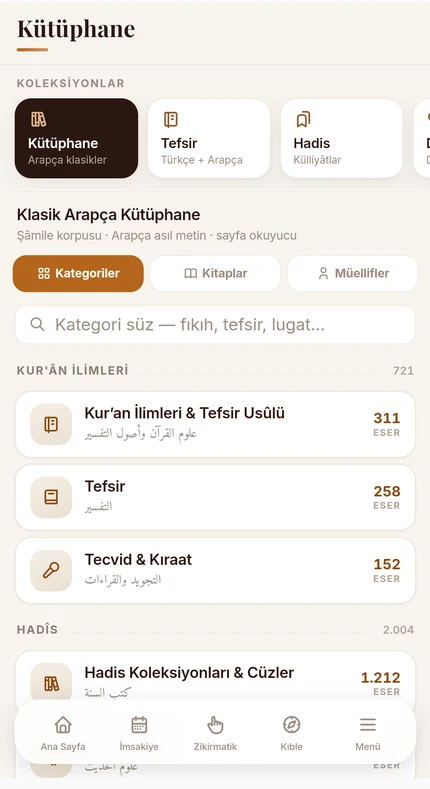
İslam Arşivi artık mobilde
Binlerce kaynağa her an, her yerden ulaşın.
Web sitemizde bulunmayan özellikleri uygulamada keşfedin.
iOS ve Android uygulamalarımız şimdi yayında!
Güvenli • Hızlı • Ücretsiz
Short Dua:
اَلْحَمْدُ لِلّٰهِ الَّذِي أَطْعَمَنَا وَسَقَانَا وَجَعَلَنَا مِنَ الْمُسْلِمِينَ
Long Dua:
اَلْحَمْدُ لِلّٰهِ كَثِيرًا طَيِّبًا مُبَارَكًا فِيهِ غَيْرَ مَكْفِيٍّ وَلَا مُوَدَّعٍ وَلَا مُسْتَغْنًى عَنْهُ رَبَّنَا
Short text: Al-ḥamdu lillāhi'lladhī aṭʿamanā wa-saqānā wa-jaʿalanā mina l-muslimīn.
Full text: Al-ḥamdu lillāhi kathīran ṭayyiban mubārakan fīhi ghayra makfiyyin wa-lā muwaddaʿin wa-lā mustaghnan ʿanhu Rabbanā.
Short text: All praise is due to Allah, who fed us, gave us drink, and made us among the Muslims.
Full text: O Lord! We praise You with a praise that is abundant, pure of things such as ostentation, and full of blessing. It is a praise that we shall in no way regard as sufficient, that we shall always continue to offer, that we shall in no way abandon, and from which we shall never consider ourselves independent. You are our Lord.
Source: Sahih al-Bukhari, At'imah 54 (sahih hadith).
Narrated by Abu Umamah (may Allah be pleased with him). The Prophet (peace and blessings be upon him) would praise Allah after eating in various forms of dua. Its three best-known forms are: the short dua (Jami' at-Tirmidhi, At'imah 50), the long dua (Sahih al-Bukhari, At'imah 54), and "Al-ḥamdu lillāhi'lladhī kafānā wa-arwānā ghayra makfiyyin wa-lā makfūrin" (Sahih al-Bukhari, At'imah 54).
Abu Umamah (may Allah be pleased with him) relates: "When the Messenger of Allah (peace and blessings be upon him) rose from a meal, he would praise Allah at the table in various ways." According to the narration of al-Bukhari, the Prophet would sometimes say "Al-ḥamdu lillāhi kathīran ṭayyiban mubārakan fīhi..." and sometimes "Al-ḥamdu lillāhi'lladhī kafānā wa-arwānā..." (Sahih al-Bukhari, At'imah 54).
In another narration the Messenger of Allah (peace and blessings be upon him) said: "Allah Most High is pleased with the servant who praises Him after eating" (Sahih Muslim, Dhikr 88). The dua at the table is recited in the awareness that the table is a gift and a favour, as thanks to Allah, for health from the food eaten, for abundance and blessing for the host if one is a guest, and for the forgiveness of our sins.
The Prophet (peace and blessings be upon him) also said: "When Allah Most High feeds any one of you, let him say 'Allāhumma bārik lanā fīhi wa-aṭʿimnā khayran minhu' (O Allah! Make this blessed for us and feed us with something better than it)." (Jami' at-Tirmidhi, At'imah 49) And if one drinks milk, he advised saying "Allāhumma bārik lanā fīhi wa-zidnā minhu" (give blessing and increase it).
O Allah, You are the One who has granted me this blessing. I was hungry, You satisfied me, You quenched my thirst. You honoured me with Islam. All praise is due to You, O Lord. Grant me the ability to give thanks for the blessings You have given, to earn my provision from what is lawful, and not to forget the hungry and the needy. May what we eat give us strength and power, and may it be a means of our servanthood to You. Amin.